Quervia Pest EliminationQuervia Pest Elimination

Subterranean Termite Treatment Lynchburg

Subterranean termite treatment in Lynchburg addresses the persistent soil moisture conditions of Central Virginia's Piedmont clay. Historic stone, brick, and block foundations in Rivermont, Federal Hill, and Diamond…
Get My Free Estimate →(804) 807-9933
Subterranean Termite Treatment in Lynchburg, VA
Quick answer
  • What's included: Full foundation trenching, crawlspace pier rodding, non-repellent liquid termiticide application, and continuous perimeter monitoring stations.
  • How fast: On-site evaluations are completed within 24 to 48 hours; active barrier treatments take 4 to 8 hours depending on foundation linear footage.
  • What it costs: Local treatments start at the $200 minimum; full home perimeter liquid barriers generally range from $850 to $2,400 based on square footage.
  • Target species: Eastern subterranean termites, reproductive swarmers, foraging worker castes, and satellite nests in structural sills.
  • How to book: Scheduling occurs directly by calling (804) 807-9933 to arrange a physical foundation measurement and crawlspace inspection.

Subterranean termite treatment in Lynchburg addresses the persistent soil moisture conditions of Central Virginia's Piedmont clay. Historic stone, brick, and block foundations in Rivermont, Federal Hill, and Diamond Hill frequently present hidden moisture pathways through deteriorated lime mortar, allowing Eastern subterranean termites direct access to structural sills. Modern crawlspace and slab constructions in neighborhoods like Wyndhurst, Cornerstone, and Timberlake feature different risk profiles, where expansion joints, plumbing penetrations through concrete, and untreated patio slabs create entry gaps as narrow as 1/32 of an inch. Rather than relying on temporary perimeter aerosol sprays that scatter colonies, remediation utilizes non-repellent liquid termiticides such as fipronil at a 0.06% active ingredient dilution. Worker termites unknowingly walk through the continuous chemical zone, transferring the compound back to the subterranean nesting galleries through grooming and trophallaxis, neutralizing the queen and collapsing the central colony within 60 to 90 days.

Selecting a perimeter barrier treatment over a localized spot treatment depends on foundation continuity and confirmed gallery distribution. If exploratory mud tubes appear isolated to a single exterior cinder block pier in a Fort Hill or College Hill home, spot treatment creates immediate localized suppression; however, unaddressed subterranean corridors leave adjacent framing exposed to re-infestation within the same season. A complete perimeter trench-and-rod application treats every linear foot of soil against both interior and exterior foundation walls, converting the entire perimeter into an impenetrable zone. Liquid barriers yield an average protective field duration of 5 to 10 years, whereas standalone monitoring stations require quarterly bait checks and active replenishment during peak spring swarming events. The trade-off centers on upfront mechanical intervention versus prolonged surveillance commitments.

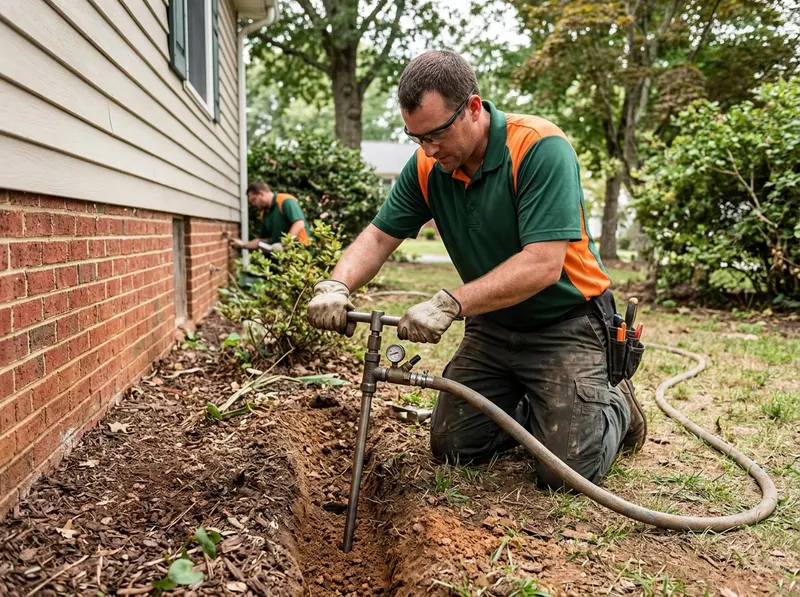
Structural remediation begins with an inspection of the band sills, floor joists, and subflooring directly adjacent to exterior grade lines near the James River and Blackwater Creek basins, where high water tables accelerate cellulose decay. Next, a continuous 6-inch by 6-inch trench is excavated along exterior foundation walls, followed by hydraulic rodding to saturate soil down to the top of the footer at a rate of 4 gallons per 10 linear feet per foot of depth. Concrete elements like carports, walkways, and porches abutting the living footprint are drilled at 12-inch intervals to inject termiticide into the gravel sub-base beneath the slab. Once injection finishes, all drill holes are patched with structural hydraulic cement, restoring foundational integrity without predatory annual chemical route contracts.

Subterranean Termite Treatment cost in Lynchburg

Spot Treatment / Pier Remediation Minimum$200 - $450
Exterior Liquid Perimeter Barrier (1,000 - 1,800 sq ft)$850 - $1,450
Full Crawlspace Rodding & Trenching (1,800 - 2,800 sq ft)$1,450 - $2,200
Monitored Perimeter Bait Station Installation$950 - $1,650
Basement Slab Drilling & Injection Add-On$350 - $750

Every job gets a firm, written price after a free on-site visit.

Common questions

How does subterranean termite treatment in Lynchburg protect historic masonry foundations?
Historic foundations in Lynchburg neighborhoods like Federal Hill and Diamond Hill often feature soft mortar joints that allow subterranean termites to travel vertically inside structural walls without building visible exterior mud tubes. Treatment involves drilling and low-pressure injection directly into the void spaces and soil contact zones, saturating the contact points to block internal travel corridors permanently.
What is the difference between subterranean termites and carpenter ants in Lynchburg homes?
Subterranean termites ingest and digest wood cellulose, leaving behind packed soil and mud tubes along foundation surfaces, whereas carpenter ants merely hollow out damp wood for nesting galleries and leave coarse piles of sawdust (frass). Eastern subterranean termites also possess straight antennae and uniform wings, contrasting with the pinched waists and bent antennae of native Lynchburg carpenter ants.
Are liquid termiticide barriers safe for households with pets and children in Lynchburg?
Liquid termiticides applied during treatment bond tightly to organic soil particles within two to four hours of saturation, creating an insoluble underground chemical barrier. Once the treated soil trench is backfilled and dry, the compound does not vaporize into interior living quarters, preventing exposure to children, pets, or non-target household surfaces.
Does a subterranean termite treatment in Lynchburg require ongoing monthly spray contracts?
A non-repellent liquid barrier does not require locked-in monthly chemical contracts because the underlying chemical barrier remains stable in clay soils for five to ten years. Long-term defense is maintained through annual structural inspections rather than unnecessary monthly chemical re-applications inside the living area.
How does rainy weather along the James River affect subterranean termite treatment application in Lynchburg?
Soil saturated by heavy rainfall or standing runoff cannot properly absorb liquid termiticide emulsions, which risks chemical displacement and uneven trench barriers. If high soil saturation is observed on a Lynchburg job site, liquid injection is rescheduled to a dry window to ensure the compound reaches the sub-surface foundation footer at the mandatory concentration.
Helpful resources

Trusted references & local links

USA.gov, government & consumer helpBetter Business BureauFTC Consumer AdviceU.S. Small Business AdministrationReady.govU.S. EPAENERGY STARU.S. Dept. of EnergyConsumer.govU.S. Census BureauGoogle Maps, Lynchburg, VA

Get started today

Tell us about your subterranean termite treatment job in Lynchburg and we'll send a clear, written quote, usually the same day.

Get your free pest control service quote, Lynchburg

We only use your ZIP to check availability, no spam.