Ant infestations in Lynchburg properties originate from distinct biological drivers that determine whether a colony nests inside structural wood or trails from outdoor soil. Older framing in Rivermont and Federal Hill…
Ant infestations in Lynchburg properties originate from distinct biological drivers that determine whether a colony nests inside structural wood or trails from outdoor soil. Older framing in Rivermont and Federal Hill historic homes often provides hidden moisture reservoirs where Camponotus pennsylvanicus (black carpenter ants) hollow out damp joists and sills behind lath and plaster, leaving fine wood shavings known as frass. Modern slab builds in Cornerstone and Wyndhurst experience regular kitchen intrusions from Tapinoma sessile (odorous house ants) and Tetramorium immigrans (pavement ants) traveling through expansion joints, utility pipe penetrations, and foundational weep screeds during seasonal humidity shifts.
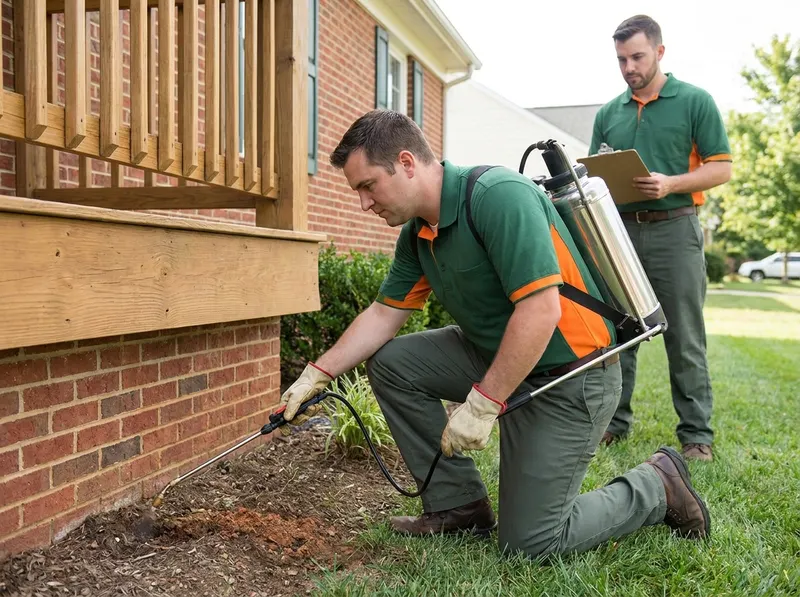
Standard over-the-counter pyrethroid perimeter sprays trigger a survival mechanism known as budding in multi-queen species like odorous house ants. When exposed to fast-acting repellent toxins, the colony fractures into multiple satellite nests across wall voids, multiplying an active infestation into several distinct rooms within 48 hours. Decisive elimination avoids fast-kill repellents entirely. Technicians introduce delayed-action, non-repellent micro-chemistries (such as fipronil or indoxacarb) that foraging worker ants ingest and carry through trophallaxis directly into the heart of the nest, systematically neutralizing the queen, nurse workers, and brood.
Following toxicological transfer, long-term stabilization requires sealing the mechanical vulnerabilities that permitted original transit. Technicians identify and caulk entry apertures along exterior masonry junctions, backer rods around electrical chases, and seal sill-plate gaps against foundation walls. Pruning tree canopies back a minimum of 36 inches from roof eaves and clearing mulch beds to maintain a 12-inch clear foundation perimeter prevents arboreal bridges across properties adjacent to mature timber stands like those bordering the Blackwater Creek Trail or older parcel lines in Boonsboro.
Every job gets a firm, written price after a free on-site visit.
Tell us about your ant colony elimination job in Lynchburg and we'll send a clear, written quote, usually the same day.
 Quervia Pest Elimination